

LtoR: Rose Delamare,Joanna Turner, Mike Poltorak, Roger Just, Max Harrison & Sarah Molisso
Third year undergraduate students have the opportunity to do a Photographic or Video Project in Visual Anthropology in the final Spring Term. For the video project the course begins with students making symbolic cameras that represent their own unique involvement and creativity in their projects. These cameras (see right), remind them of their artistic and creative visions during the trials and challenges of the collaborative process. The resulting videos are screened in the Summer Term to an enthusiastic group of staff, students and visitors. Two prizes are awarded. The first, the Roger Just Visual Anthropology Prize, is awarded by Professor Roger Just, much admired by students for his inspirational teaching. The second prize is voted on by the audience. This year the judges decided that Runners Up prizes were also awarded. Below are the projects, click on the link to see some of the films and learn more of the projects.
Sarah Molisso The Bubble (Runner Up Roger Just Visual Anthropology Prize)
Joanna Turner & Rose Delamare Young at Heart (Runner Up Roger Just Visual Anthropology Prize) Rosemary Headland & Dulcie Ruttley-Dornan Naughty Legs Becca Toop Homeless but Not Helpless (Runner Up-Audience Prize) Julian Warner Who Arrested Will and Gregg
Rehearsing Reality: Land Rights and Culture amongst the Landless in Brazil – Nina Simoes
April 10, 2011
Siroccosky
In her film Rehearsing Reality, Nina Simoes explores the lives and faces of Brazil’s Landless Movement and their struggle for land at the point of interaction with Boal’s Theatre of the Oppressed, a technique that breaks with the conventions of traditional theatre by transforming passive beings into active participants of a theatrical scene. As part of the Film & Advocacy Series, Nina Simoes participated in a Q&A on the 2nd of February 2011 concerning the above issues.
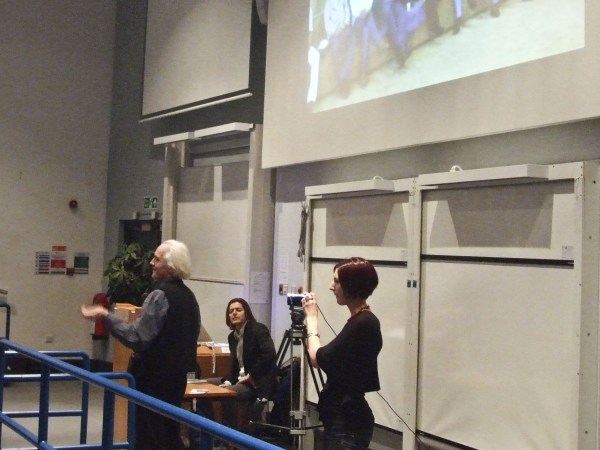
A retrospective examination of Hugh Brody’s life in Film and advocacy. Presented as part of the Film and Advocacy series, hosted by Visual Anthropology at the University of Kent, 26 January 2011.
A new online journal using audio-visual material has recently been launched by Harvard University called Sensate. It’s worth taking a look at. This is one of a couple of peer-reviewed audio-visual journals appearing (for example Journal of Visual Experiments is a peer-reviewed video journal from which the video articles can be viewed and referenced as a normal academic text), and hopefully will be a trend that continues; for academia to remain stuck in text when the world around us is evolving and changing means not only that we risk being old fashioned by not keeping up, but more importantly, that we risk continuing elitism and exclusion of people outside academia. Maybe some disciplines like this, but for anthropology, which grounds itself so centrally in the lives of people, and especially for visual anthropology, which offers outstanding opportunities for public engagement in anthropology, it seems detrimental. I hope this trend continues and we see an expansion of the kind of work not only valued by academia, but also made public and engaging.
Kicking off the Film and Advocacy series for 2011 was Hugh Brody, with a retrospective look at his career and his work in filmmaking and visual anthropology. Below are some photos from the evening. At some later point, there will be a podcast to download and a film of the event, but this has yet to be edited!
Vodpod videos no longer available.
The following is an audio-recording and photos from the teach-in at the University of Kent on December 8th, 2010. The event was part of the National Day of Action against the proposed tuition fee increase and cuts to public funding of Higher Education. Speakers included John Fitzpatrick, David Ormrod, Julia Twigg, Peter Taylor-Gooby, Jan Pahl and Helen Wood.
Vodpod videos no longer available.As part of our course, we are required to engage with the local community by collaborating with a local organization and producing a multimedia document that will contribute to their concerns and issues. This is part of a move towards creating a more engaged, public anthropology based on reflexivity, collaboration and advocacy. So, after several weeks trying to find a good placement location, today was my first visit to the Canterbury Open Centre, run by the independent Canterbury-based charity, Catching Lives.
The Canterbury Open Centre is staffed entirely by volunteers and is open from 9am until 1pm, Monday-Friday, to provide a variety of facilities to the homeless of Canterbury. This includes breakfast and lunch, showers and access to donated clothing. They also provide a mental health clinic, as well as dentist and GP services. I thought this would be a fascinating place to do a multimedia project that will not only benefit me, but the organization itself.
And so, today, I visited the Canterbury Open Centre after it had closed to the public and was shown around the building by Terry, the Deputy Service Manager. I brought a still camera with me, so that I could take photos of the location itself (a similar exercise to what we did in Week 1 of the course). As anthropologist and linguist Stephen Feld writes, “as place is sensed, senses are placed; as places make sense, senses make place.” I thought that getting a sense of the place – minus the people – would allow me to better understand the people themselves. They would clearly have their own senses of place and their own attitudes, feelings and associations with the Canterbury Open Centre so, perhaps, getting my own sense of place would help me understand this. What’s more, Jean Rouch writes in The Camera and Man that “the ethnologist should spend quite a long time in the field before undertaking the least bit of filmmaking.” This particularly influenced me in my approach; although there are obvious time constraints to this project, I thought I should not rush into it and, instead, take time to better understand the subject matter. Taking a few simple photos of the Canterbury Open Centre today, I think, allows me to do this.


Les Maitres Fous
In 1955, filmmaker and anthropologist Jean Rouch made Les Maîtres Fous, considered the first film of the ethnofiction genre. Ethnofiction, a branch of Docufiction, blurs the line between documentary and fiction, using actors and scripts (or, in some cases, improvisation) to portray and represent ethnographic issues. Although it is sometimes a difficult genre to define, according to Wikipedia (often a useful source in defining such contemporary terms), it can refer to “any fictional creation with an ethnographical background.”
The other week, we were lucky enough to be given a talk by a prominent figure in the study and making of ethnofiction films, Johannes Sjöberg. Working at the University of Manchester and focussing on the overlapping of Anthropology, Media and Drama, Sjöberg discussed his recent ethnofiction film, Transfiction. After 15 months of fieldwork in São Paulo amongst transgender communities, Sjöberg asked Fabia Mirassos and Savana Meirelles to use improvisation to act out scenarios that they felt represented transgender identity in São Paulo. As the film’s website explains, although Transfiction is a fiction film, “it is made as an ethnographic documentary where story and dialogue are created in the moment.”
Hearing Johannes Sjöberg speak and learning about ethnofiction reminded me of an article I read a few weeks ago, David Samuels’ Alien Tongues. In this article, published in the book E.T. Cultures: Anthropology in Outerspaces, Samuels speculates on what an alien language would sound like, whilst also revealing a lot about human language. As anthropologists often try to describe the “other” – or “alien” cultures – Samuels believes it would seem appropriate to discuss the anthropological aspects of the belief in real aliens. Suddenly, science fiction films such as Blade Runner, Planet of the Apes and District 9 came to my mind. I realized that many films (including science fiction films) can, to some extent, be regarded, as works of ethnofiction. Indeed, at times, some of the most powerful critique of present day culture can be found in fiction, where filmmakers create whole worlds, stories and characters based on the issues of today. Perhaps the genre of ethnofiction is wider than we imagine…

City of God
As well as being a pioneer of Cinéma Vérité (the genre to which his most famous work, Chronique d’un été, belongs), Jean Rouch is also widely regarded as one of the forerunners of the French New Wave movement. Therefore, we can compare, for instance, Rouch’s Chronique d’un été with Jean-Luc Godard’s New Wave classic Breathless, which depicts a realist 1960s Paris. Jean Rouch and Jean-Luc Godard were even friends, often exchanging ideas and critiquing each others films. French New Wave, in turn, was heavily influenced by the Italian Neorealism movement of the 40s and 50s, which includes a favorite film of mine, Vittorio de Sica’s Umberto D. This film follows the elderly Umberto, as he copes with poverty and desperation in post-war Italy. Typical of Italian Neorealist films, it aimed to reflect the difficult economic and social conditions of every day life, whilst also using non-professional actors and on-location filming. More recently, we have films such as City of God, which draws upon these traditions of the French New Wave and Italian Neorealism, depicting organized crime in Rio de Janiero and using actual residents of the favelas as actors. This brings us nicely back to Sjöberg’s Transfiction.
To briefly sum up, as Jean Rouch points out in his article The Camera and Man, there has been a close link between anthropology, ethnography and film since the very dawn of cinema itself. And, since 1895, when Felix Regnault used “time sequence photography” to study the movement of the human body in motion, it is clear that this link has evolved in countless ways. Many anthropologists, such as Jay Ruby or Marcus Banks, claim different, sometimes quite narrowminded, definitions of what they call “ethnographicness” in film and photography (Ruby, it should be pointed out, believes only an anthropologist can make a true ethnographic film). But, in my opinion, “ethnographicness” is not even something found exclusively in documentaries, although these are, perhaps, the only types of films where “ethnographicness” is intentionally made explicit. Many films, whether we realize or not, may contain aspects of ethnofiction and, to varying extents, use fiction to deal with anthropological issues. I think the genre, if we can call it that, really is wider than it seems.
I fell upon an article earlier which looks at the way rock engravings, far from being simple visual representations, have a far more sensual aspect to them, in which sound and feeling is as important as vision, at least within the San of Southern Africa. It’s very interesting, and well worth a look:
Ouzman, S. (2001) ‘Seeing is deceiving: Rock Art and the Non Visual’ World Archaeology Vol 43(2) – Archaeology and Aesthetics (october 2001). Pp 237 – 256.
 Kent Visual Anthropology (2010-2020)
You must be logged in to post a comment.